Co-Processor for the Apple II

The missing
Link.

Your Apple II has come a long way: accelerators, storage by the gigabyte, RAM disks, and sharp modern video. The one thing none of it can fix is the modern web, locked behind TLS that no 6502 or 65816 can reasonably run.

CoGS is the key. A single slot card that does the impossible parts on the card: TLS, HTTPS, JSON, true random, and hardware hashing, handing your Apple II plaintext. The machine stays in charge of everything else. It is still your Apple. It can just finally talk to the world.

And the network is a disk library

Drop the card in a slot, power on, and its own config ROM comes up. You join Wi-Fi, pick a category, browse a catalog of over 1000 disk images right on the machine (Total Replay rides along with 500+ 8-bit titles), and hit Return. Your Apple boots it, streaming over the internet, block by block, with nothing installed and no local storage at all.

From power-on to running essentially any published Apple II app ever written is about one minute: boot, join Wi-Fi, browse, Return, and it RUNS. One card, any Apple II: the same board drops into a slot in the ][+, the //e, or the IIGS. On a IIGS the same card also streams 200+ songs and internet radio through the Ensoniq and shows 700+ box covers and title screens.

Ethernet/Wi-Fi/TLS/SHA‑256/TRNG/Clock/Network disk/Audio/Pictures

Drop it in a slot. That is the whole install.

One card. Nearly every Apple II application ever published, streaming.

No OS, no boot disk, no setup software, no SD card to fill. Seat the card, power on, join Wi-Fi once, and the card's own screens put over a thousand disk images, hundreds of songs, and hundreds of box covers one Return away, on the machine itself. On a ][+, a //e, or a IIGS.

Zany Golf running on the IIGS, streamed from the network disk: putting on the Windmill Hole

Disk images

1036 disks, boot tested

Browse by category (games, music & art, education, utilities), by machine, or A to Z. Hit Return and your Apple boots it over the network, block by block, with nothing installed. Total Replay's 519 arcade titles are in the same list. Point it at your own share for read/write.

How the network disk works →
The player's eight-band graphic EQ on the IIGS with Flat, Class, Rock, and Synth presets

Audio streaming IIGS

239 tracks and 54 radio stations

SoundSmith songs from the demo scene, pop covers, and the holiday shelf play natively through the Ensoniq. PCM tracks and live internet radio stream through the card, which transcodes MP3 on the fly. EQ, shuffle, playlists, and background play while you use the desktop.

The player →
Neuromancer box art as the IIGS shows it: 320x200 Super Hi-Res, decoded from the exact bytes the card streams

Picture viewing IIGS

724 box covers and title screens

Press V on any disk and its box art fills the screen: 539 covers in Super Hi-Res, 185 Total Replay title screens in HGR and double hi-res, all served as the raw bytes the video hardware wants. Browse them by format, mark a few, and run a slideshow.

The viewer →

The gap

The hard upgrades are solved. The modern web still isn't slot-native.

Already solved on the Apple II

  • Acceleration many times faster than stock
  • Storage solid-state, instant, silent
  • Memory cheap RAM and huge RAM disks
  • Display clean output to a modern panel
  • Sound sound cards well past the beep

Each upgrade follows one quiet rule: more capable, still itself.

The part still missing

The modern secure internet, in a slot.

Every useful API is HTTPS now: certificate chains, key exchange, X.509 parsing, a handshake state machine — then JSON on top. That is not a “needs more megahertz” problem; it is months of fragile cryptography with no business on a 1 MHz to 2.8 MHz CPU. It has been solved before, and solved well: purpose-built hardware has terminated TLS on the device for vintage machines for years, and offloading the hard cryptography is exactly the right call.

CoGS makes that offload a slot-native co-processor — purpose-built for the Apple II bus, with the speed, low latency, and on-card co-processing only a slot makes possible.

What it does

A network card and a co-processor toolbox.

Every service is a job the host genuinely cannot do, or would be absurd to ask of it. Everything else stays on the Apple II.

Secure web

Your Apple II talks to real HTTPS APIs directly. The card runs the whole TLS handshake and verifies the certificate; the host only ever sees plaintext.

Desk-verified

JSON, without parsing JSON

Ask for choices[0].message.content and the card returns just that value out of a whole API response. A 64 KB machine never touches a parser.

Desk-verified

True random numbers

Real entropy from hardware silicon. No Apple II ever shipped with a hardware RNG. Now yours has one.

Desk-verified

Hardware hashing

Single and double SHA‑256 in dedicated silicon, for the cost of a few register writes. Checked byte-for-byte against the reference.

Desk-verified

A real hardware miner

Hand the card a block header once; it grinds nonces locally at roughly 2400× a stock GS and returns the winner. Your GS keeps running the protocol and the UI.

Desk-verified

Your modern NIC

Wi-Fi out of the box, with wired RJ45 on the CoGS card shipping soon — plug and play. In bridge mode your Apple II gets its own IP and is a real host on the LAN, so Marinetti and IP65 software just works, now with co-processing behind it, carrying your Apple into the 21st century.

Bridge verified on real hardware

Audio on the GS

The card-injected CDA is also a player. Browse the a2cogs catalog by shelf, play SoundSmith songs natively through the Ensoniq (Tool219), stream PCM tracks and internet radio through Tool226, built on Petar Puskarich’s Tool225 (used with permission), set EQ, and leave it playing in the background. The card transcodes MP3 to the PCM the GS wants.

239 tracks · 54 stations

Pictures on the GS

Press V on a disk and its box art fills the screen. The card streams the raw Super Hi-Res, HGR, or double hi-res bytes and the CDA blits them straight into video memory: no decoder on the host, no files on a disk. 724 covers and title screens, browsable by format, with a marked-picture slideshow.

New in firmware 0.181+

Boot off the network

Give the card a link to a disk image — on your own network or anywhere on the internet — and the Apple II sees a real drive: it boots from it, reads it, and writes it back. No driver installed on the host, nothing on a local card. The card speaks SmartPort and ProDOS block right out of ROM.

Streaming on real hardware

A clock

The card runs NTP for secure time anyway, so it can set your machine's clock. For everyone whose No-Slot Clock battery died decades ago.

Time synced

Card vitals

The card reports its own health: on-chip temperature, the slot's +5V rail (a free read on your host power supply), uptime, a unique serial, and why it last booted. It answers even with Wi-Fi down, and shows up live in the desktop control panels.

Working

It updates itself

About / Update checks a2cogs.com right from the machine, lists releases with dates and build notes, and the card downloads, verifies, and flashes the one you pick. No cable, no other computer, ever.

New in firmware 0.73+

Native to the machine

It feels like part of your Apple. Because it is.

Hardware is only half of it. CoGS is built to disappear into the Apple II you already know — configured from the desktop, and wired into the network stack the community already uses.

CoGS Control Panel on the GS

Set up and watch the card right from the machine, no serial cable and no guesswork. One on-card configuration, three faces, so a change in one shows up in the others — in whichever place suits the moment:

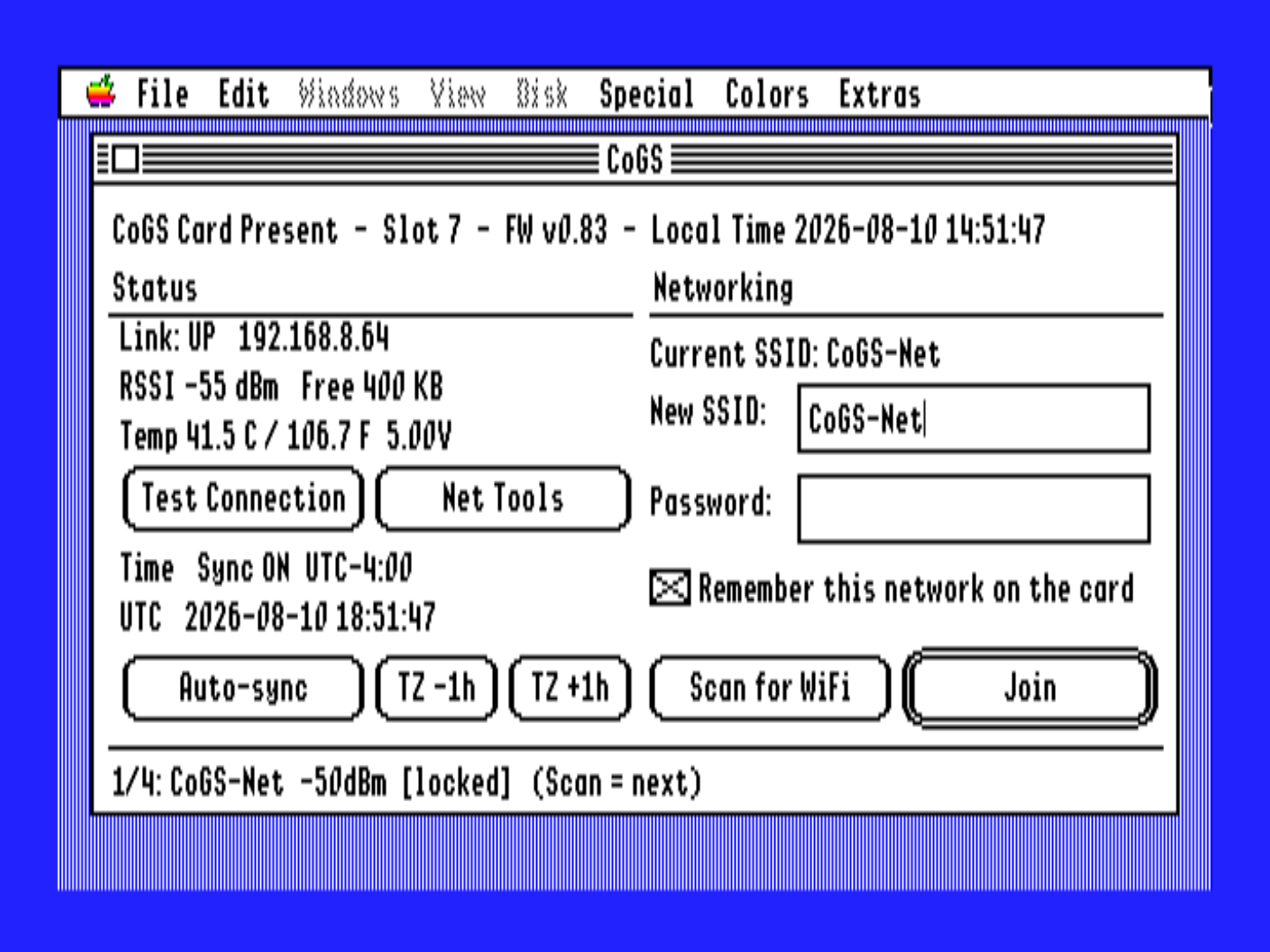
  • Control Panel (CDev) — the first-class config home, right next to TCP/IP and Time. Scan for nearby networks and pick one, join Wi-Fi, run a live connection test, set your time zone and auto-sync the clock, and see your network at a glance (SSID, IP, subnet, gateway, DNS, MAC).
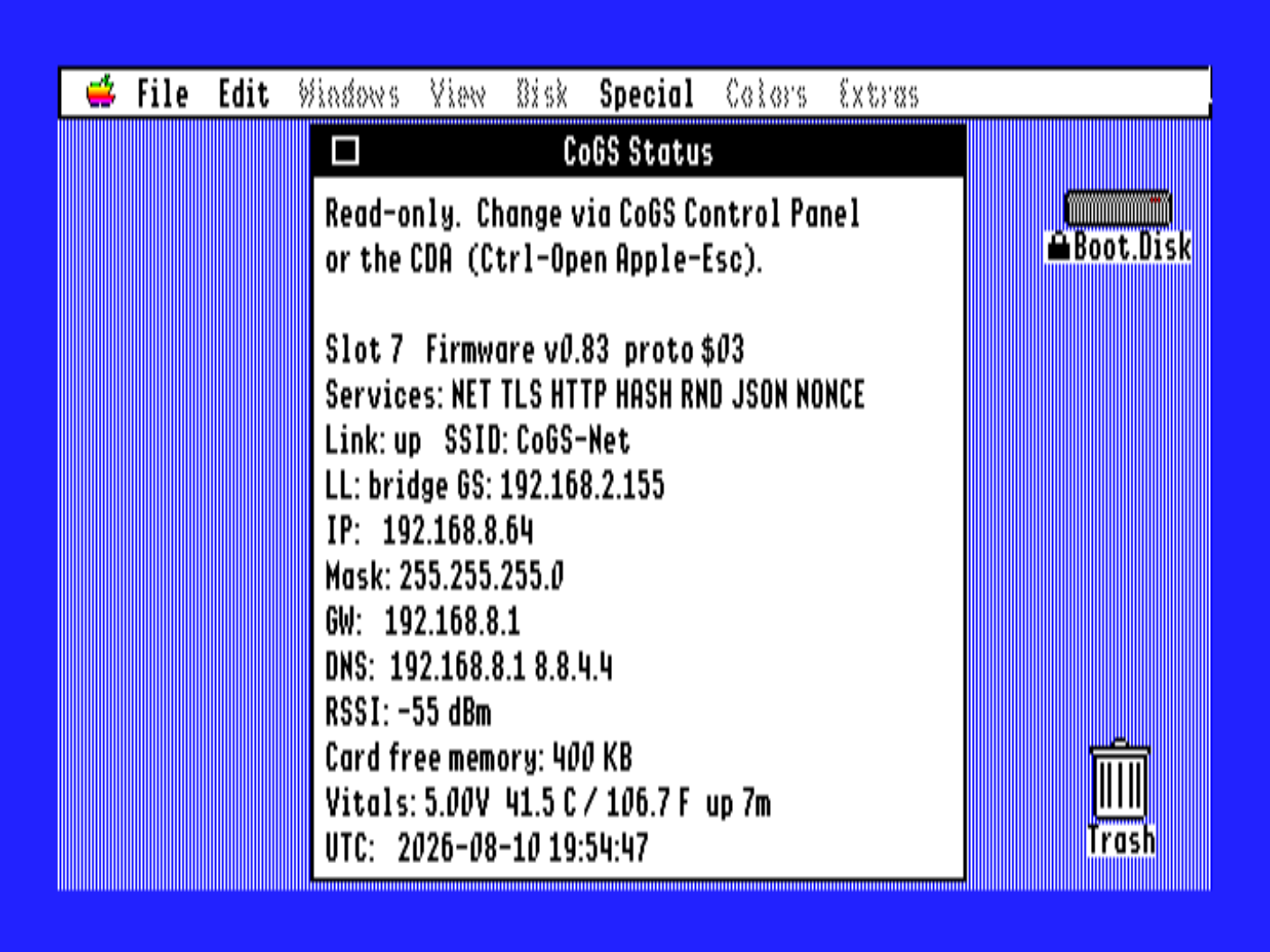
  • Status (NDA) — a thin live-status window in the Apple menu that floats over any app: link, IP, signal, the full network read-out, and the clock, updating as you watch.
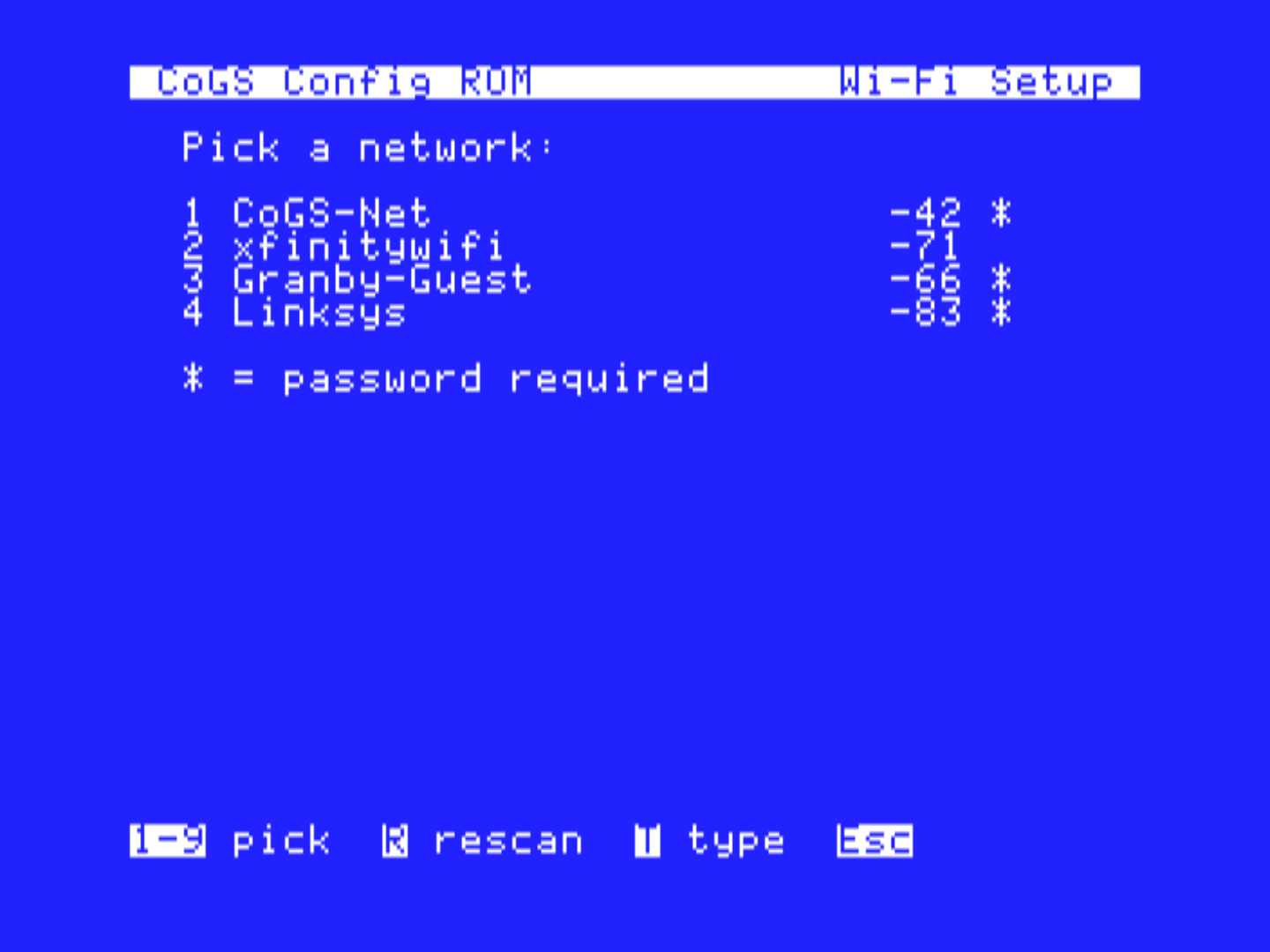
  • Console (unified ROM/CDA) — the bare-metal rescue tool. At power-on it is the card's boot ROM; on a GS/OS boot the card installs the same console as a Classic Desk Accessory automatically, reachable with Ctrl‑⌘‑Esc even on a half-booted machine. Nothing to install on the disk. Scan and pick a network, bring Wi-Fi up, run the network tools, set the clock, browse and mount network disks, play the a2cogs audio shelves or internet radio, and view the box art.
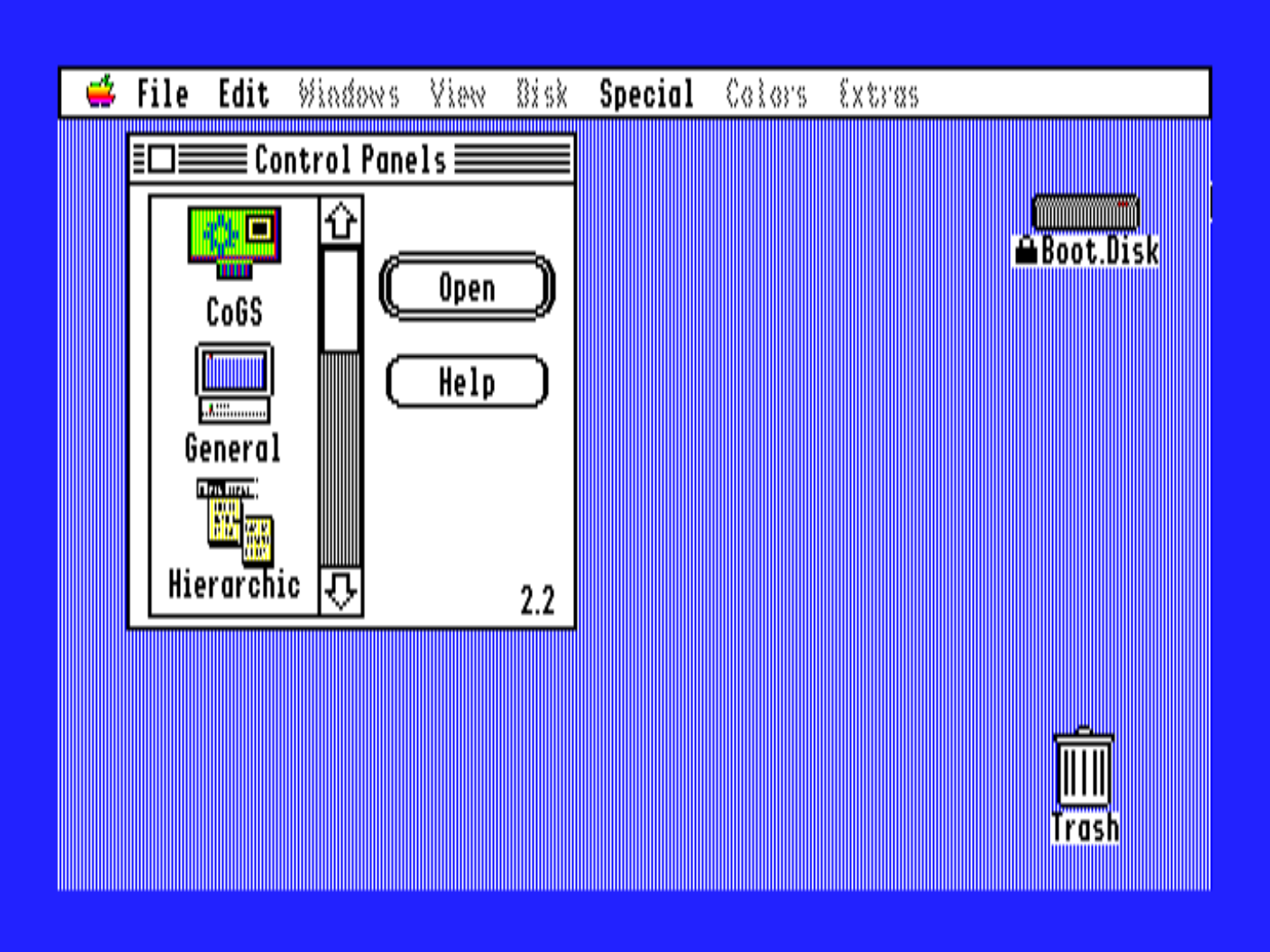
The CoGS control panel sitting in the GS Control Panels list
CoGS Control Panel (CDev): status, networking, clock, and Wi-Fi join
CoGS Status (NDA): live link, bridge and GS IP, card vitals, and clock floating over the desktop
Wi-Fi scan in the unified ROM/CDA console: nearby networks with signal bars, pick one and type the password
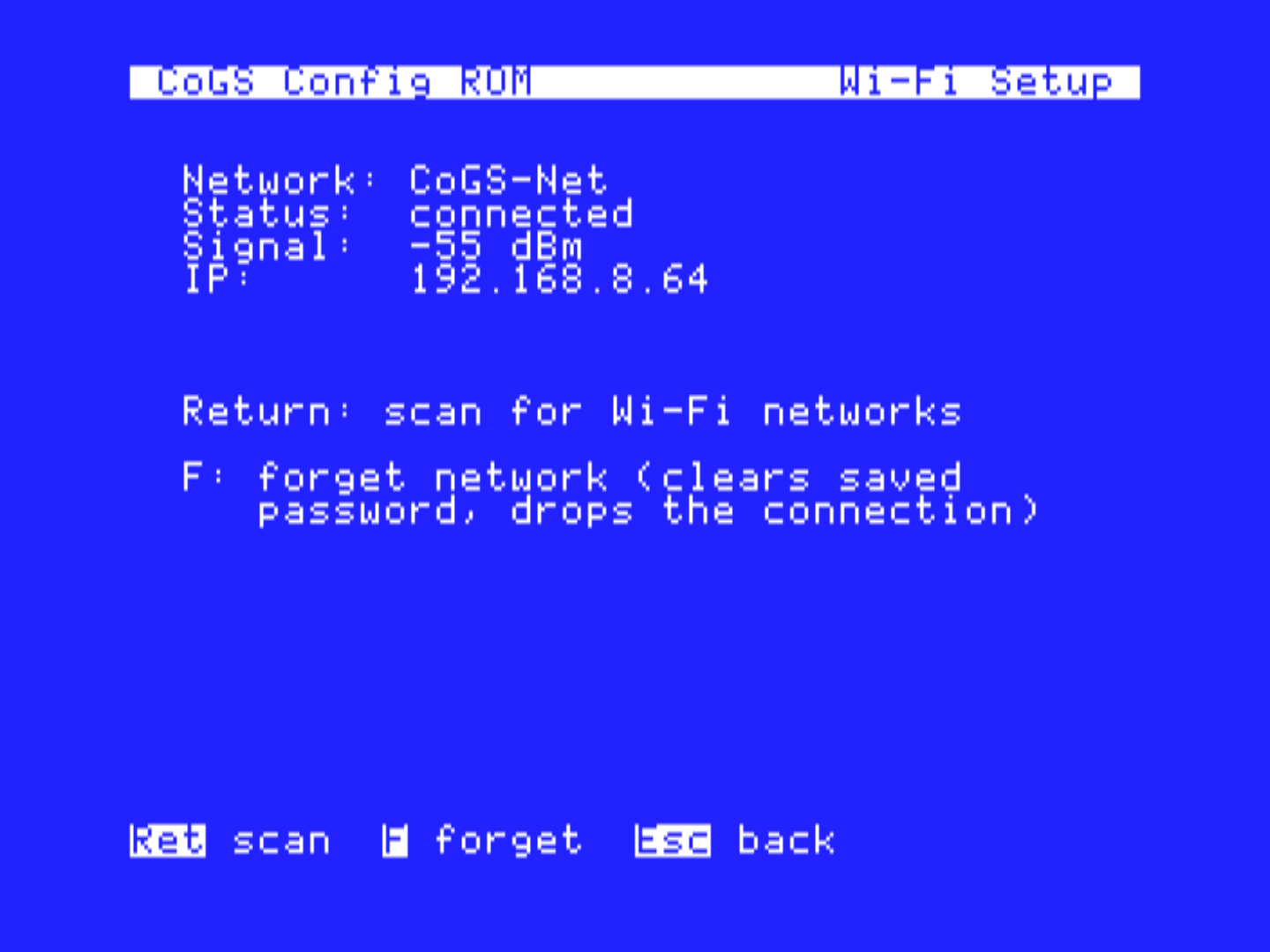
Wi-Fi Setup after joining: SSID, IP, and link state, saved to the card
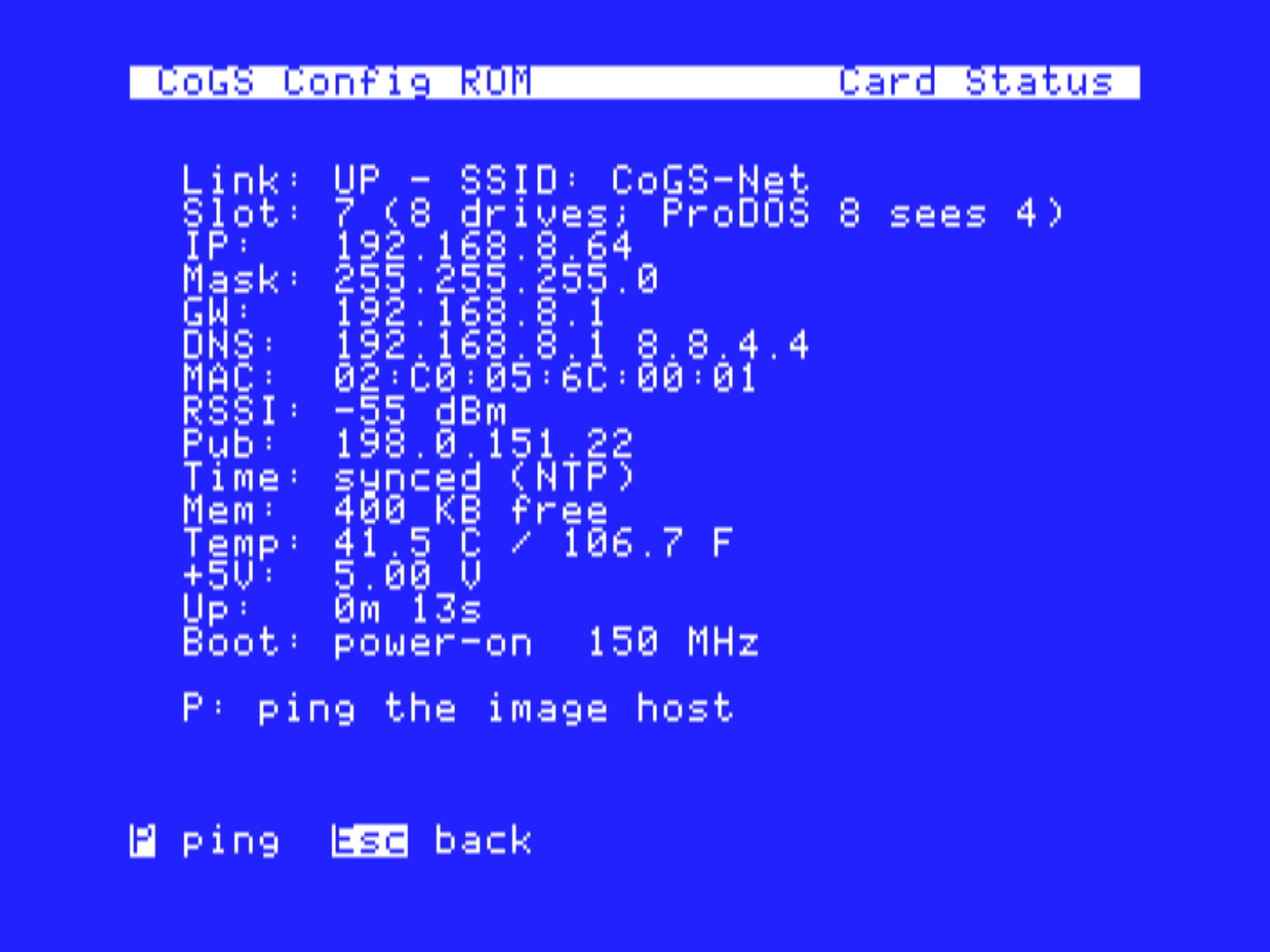
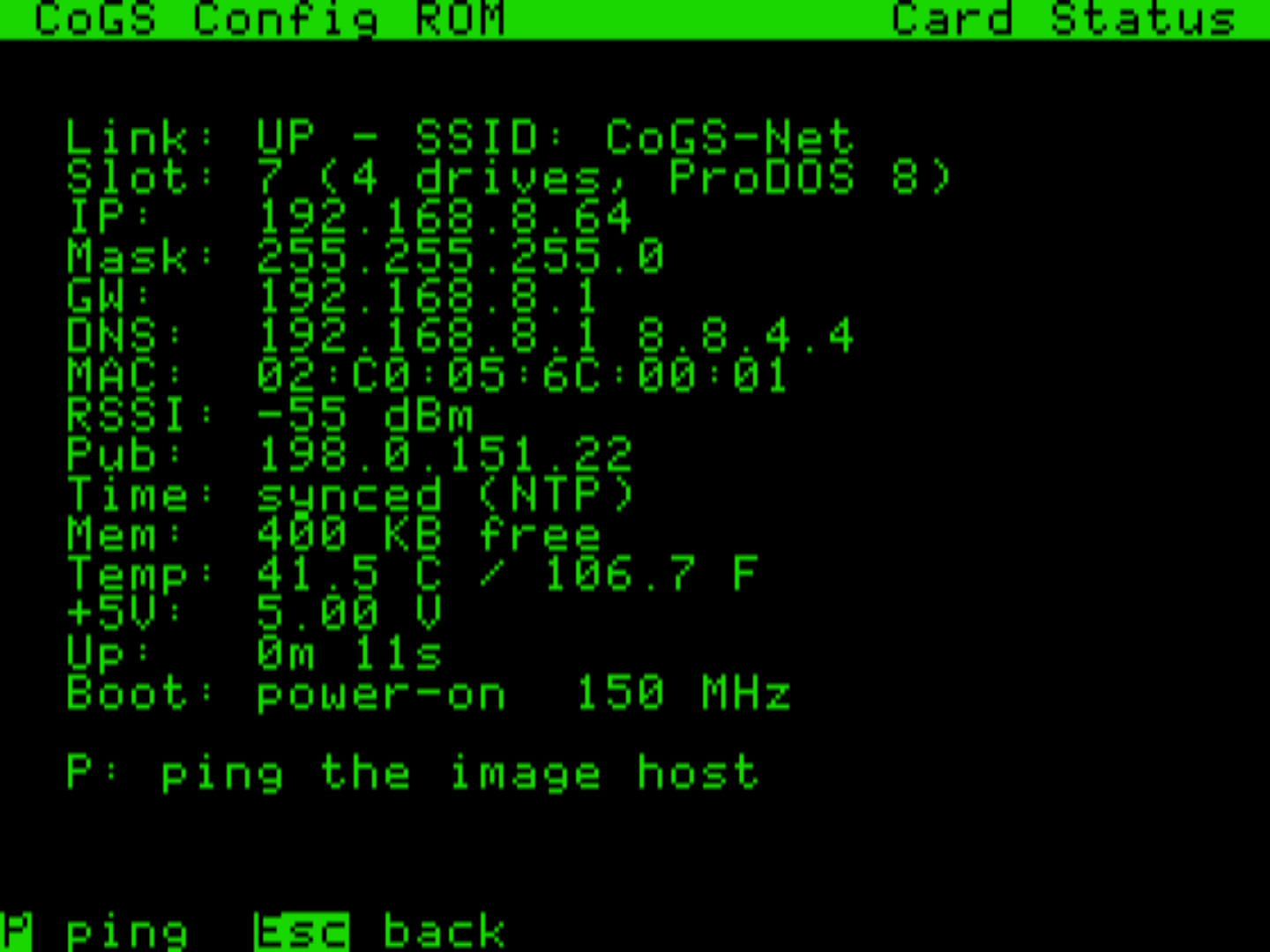
Card Status in the console: link, IP, subnet, gateway, DNS, MAC, signal, public IP, time sync, and card vitals
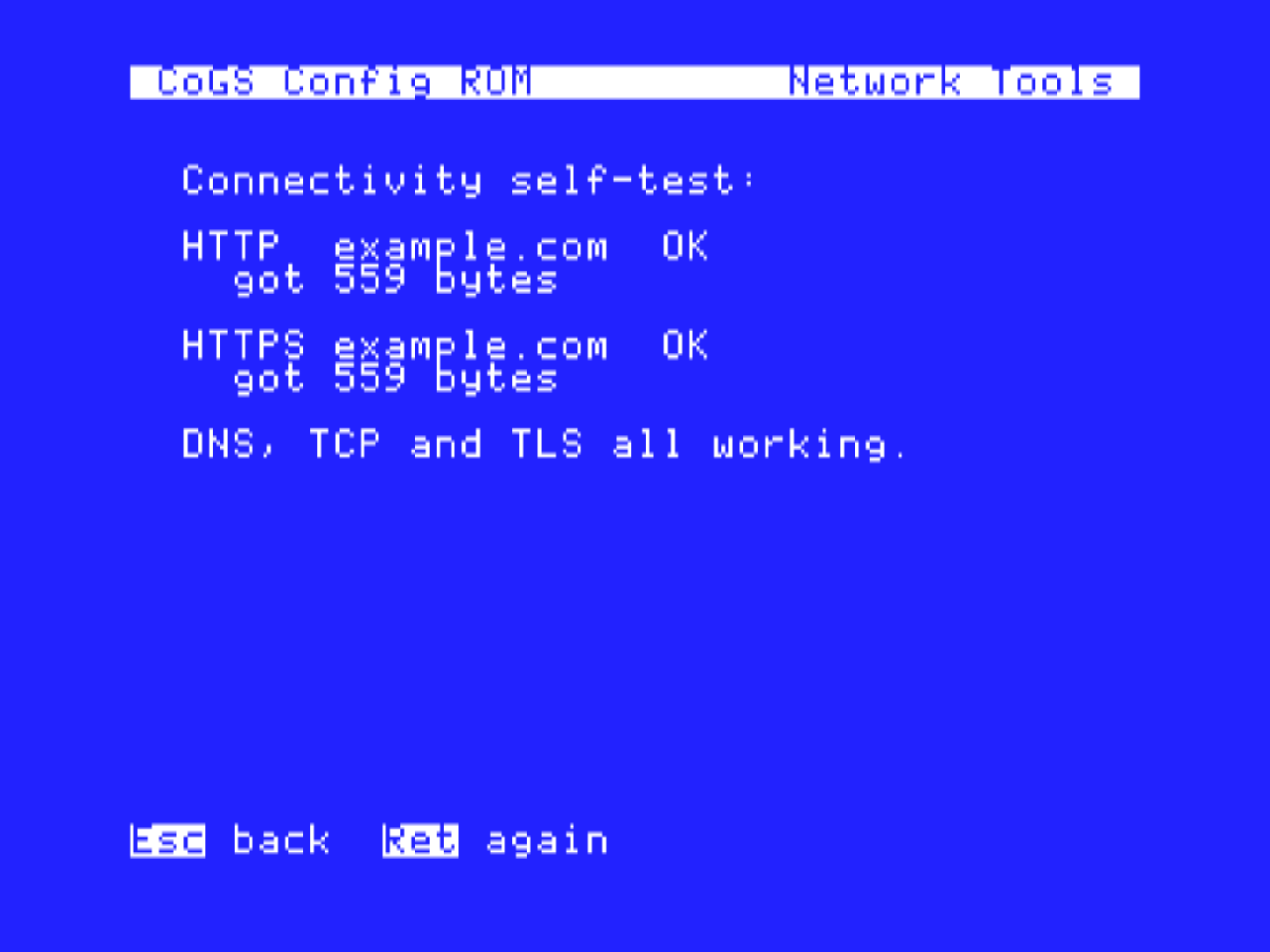
Connectivity self-test: link, DNS, gateway ping, internet ping, and an HTTPS fetch, each with a pass mark
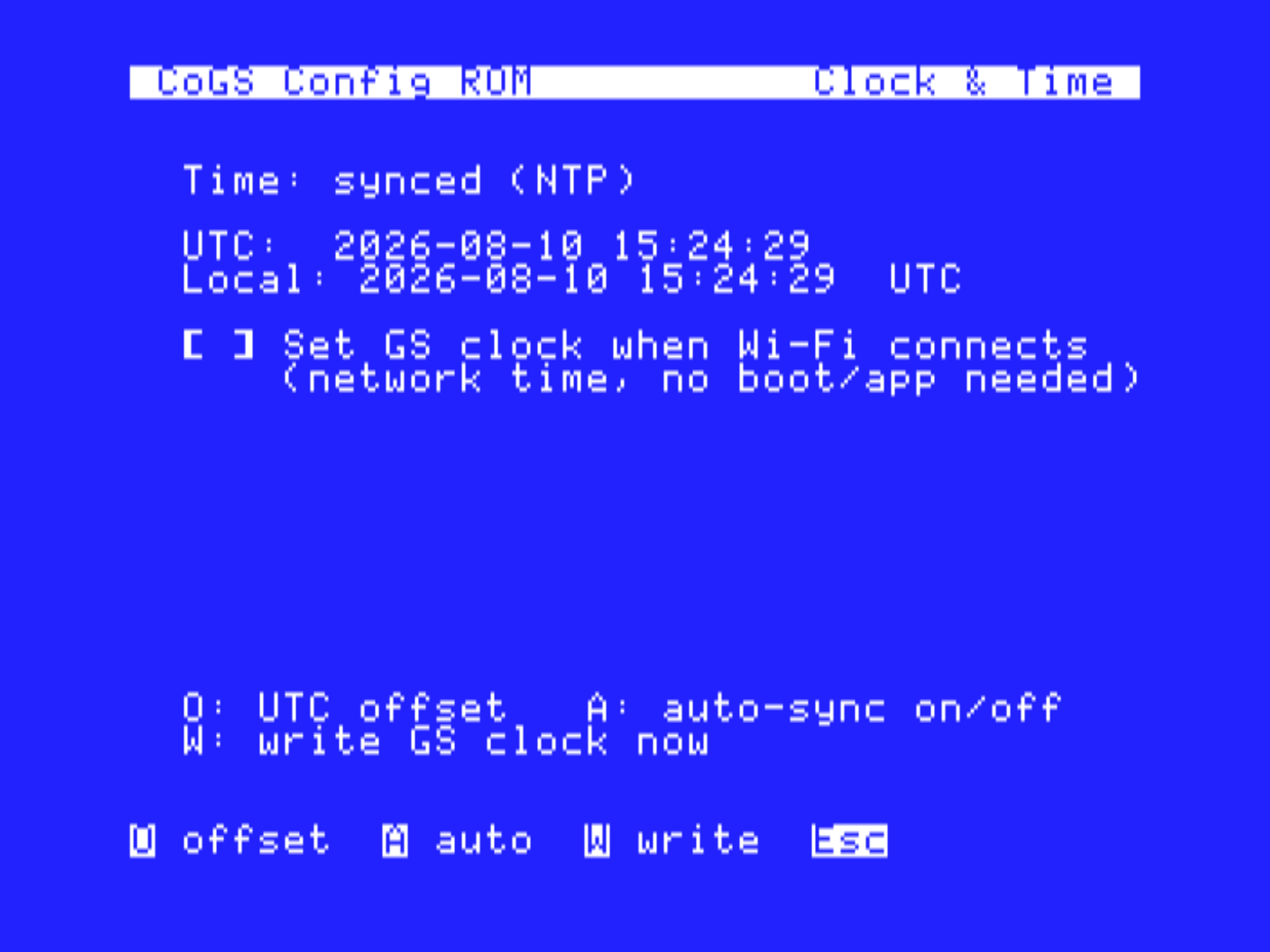
Clock & Time: network time over NTP with time zone, auto-synced when Wi-Fi connects
Working on hardware

Marinetti GS Link Layer

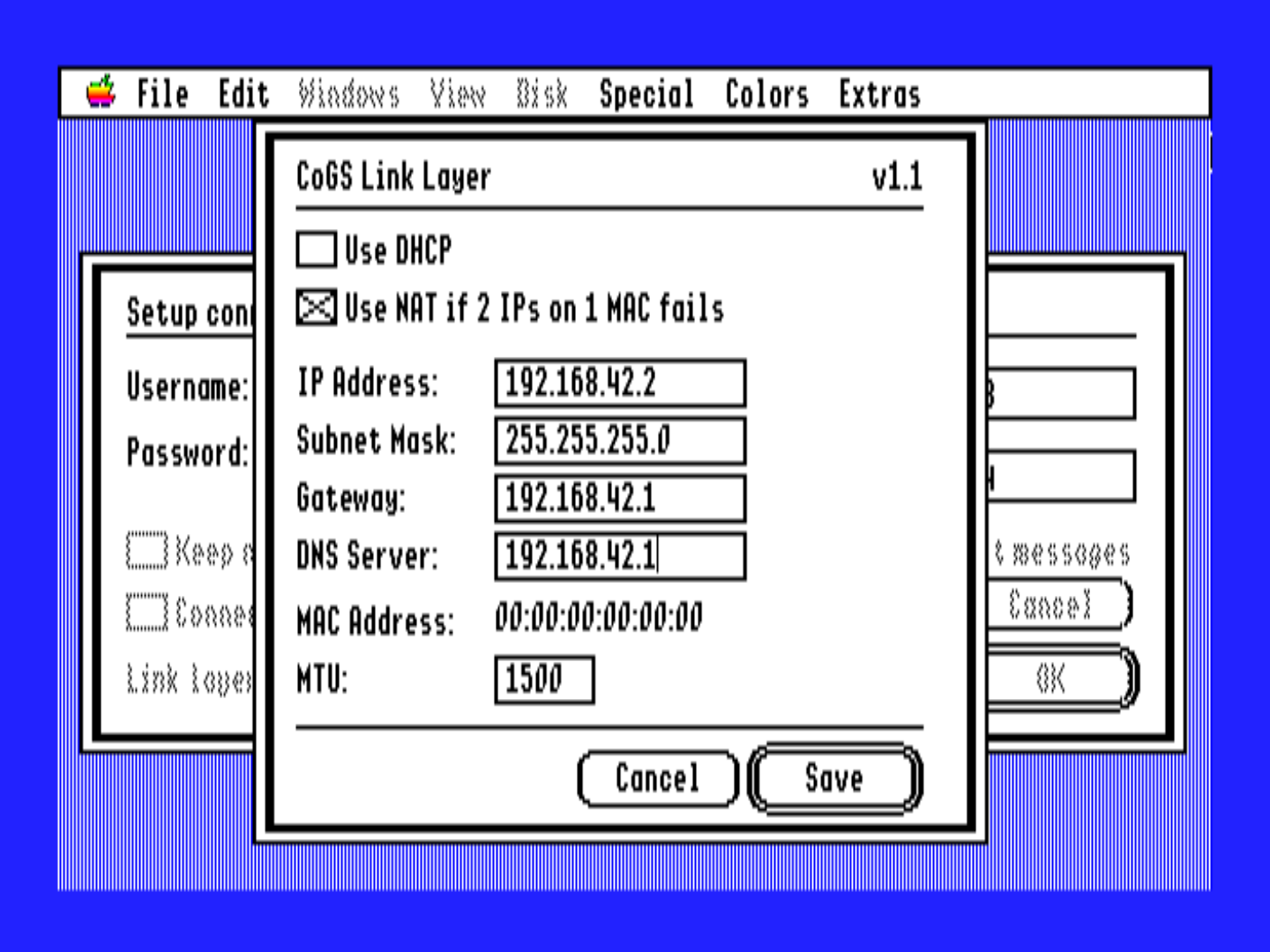
A native link-layer driver so the whole Marinetti TCP/IP ecosystem runs over CoGS. In bridge mode the GS gets its own IP and is a first-class host on your LAN (you can ping it from your Mac), so existing Marinetti apps — mail, web, IRC — run unchanged. Verified on real hardware, with a NAT mode for networks that need it.

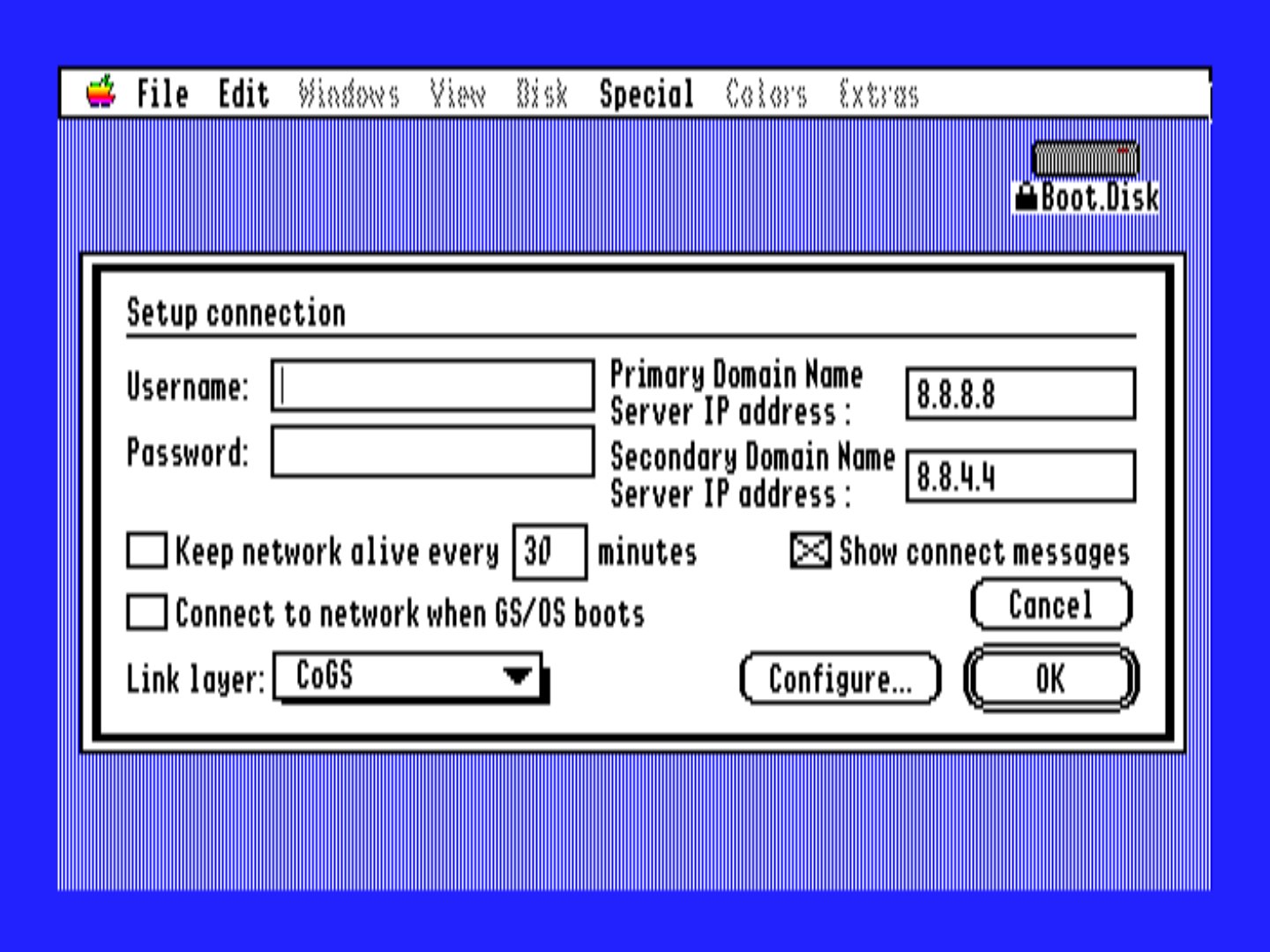
Marinetti TCP/IP Setup, with the Link layer set to CoGS
CoGS Link Layer config: DHCP or NAT mode, static IP, subnet, gateway, DNS, MAC, and MTU
Working

Every Apple II

A slot is a slot. The same card on the same open A2Pico carrier runs in the ][+, the //e, and the IIGS. And the config ROM means the 8-bit machines get the full experience with nothing installed: power on a //e, join Wi-Fi, pick Play a game, and boot any of 528 8-bit games streaming over the network, Total Replay's 519 arcade titles among them, one Return away. The cc65 / ProDOS 8 client covers the co-processor services (DNS, TCP, and a TLS 1.2 HTTPS handshake on the card) for software that wants them.

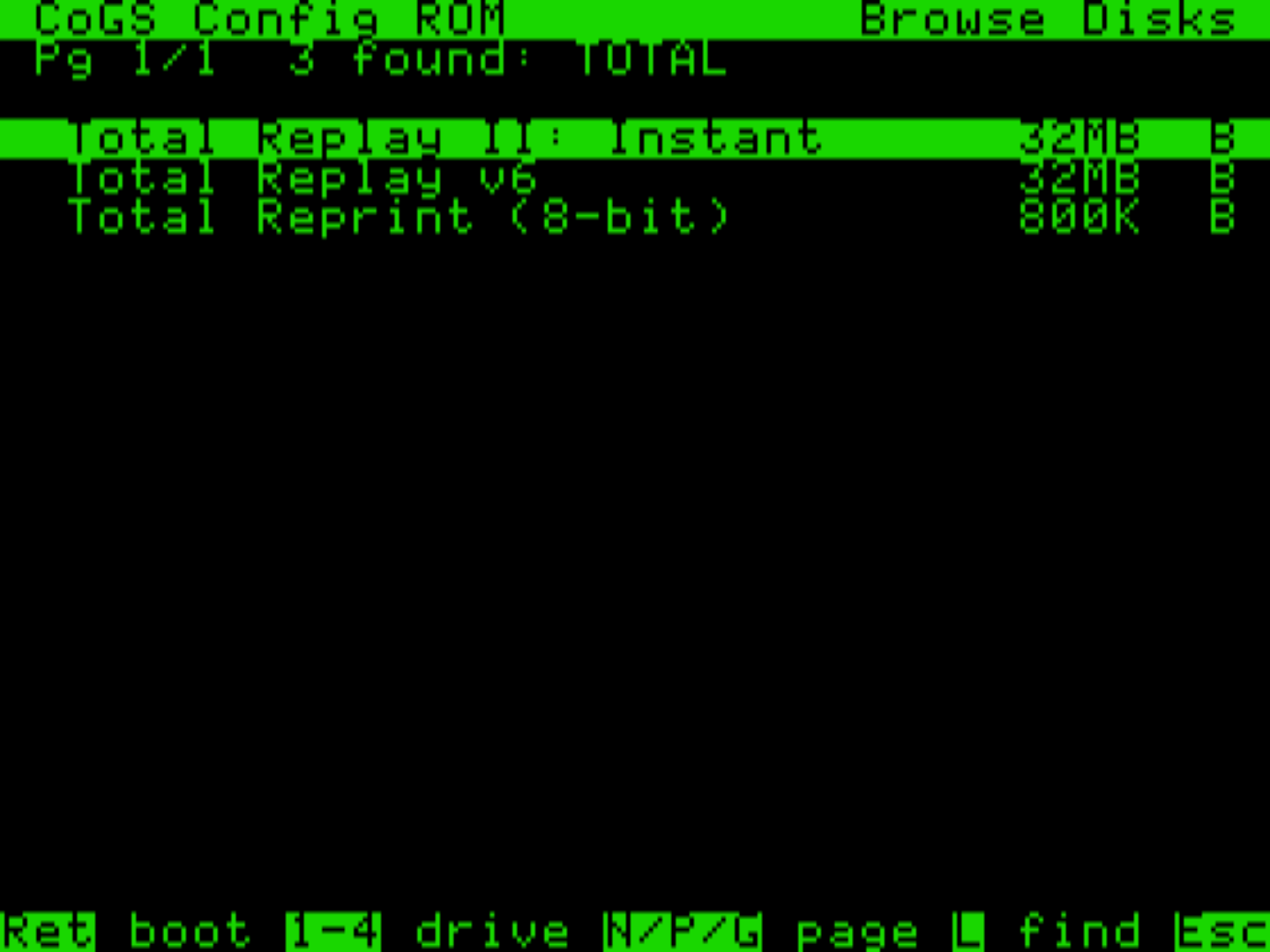
Whole-corpus search on an Apple //e: typing TOTAL finds Total Replay, one Return from booting its 400+ titles over the network
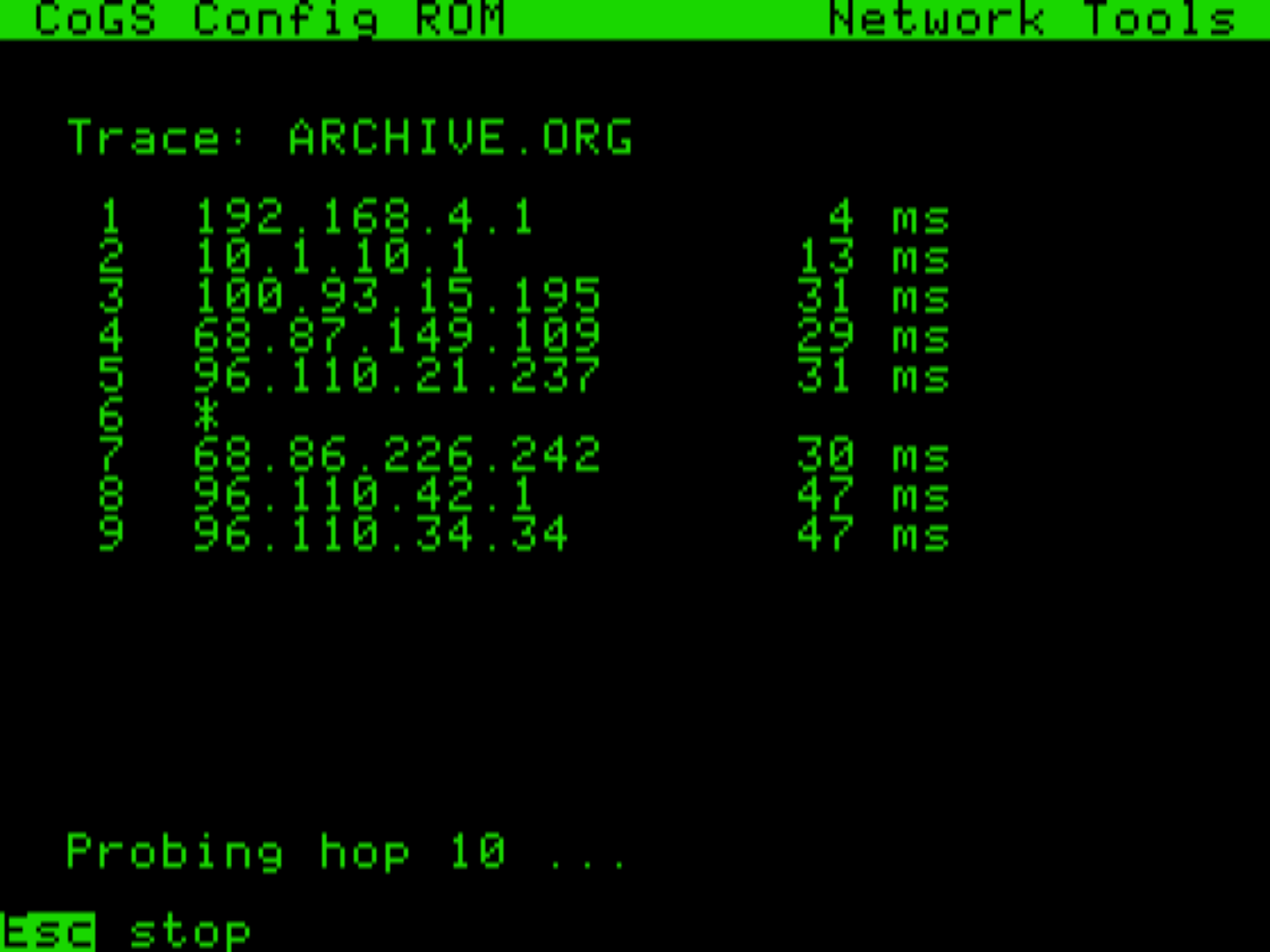
A live traceroute to archive.org running on the //e's green phosphor screen, hop by hop with round-trip times
Working on hardware

Audio on the IIGS

The CDA is also a player.

Open Browse Audio and the card asks what you want to hear: 94 SoundSmith songs off the old BBS and hard-drive shelves, 33 demo-scene tracks (the FTA catalog among them), 43 pop covers, the holiday shelf, and 59 PCM tracks, 239 in all, plus 54 internet radio stations. SoundSmith plays natively through the Ensoniq with Tool219. PCM and radio stream through the card into Tool226, based on Petar Puskarich’s Tool225 (baked on the card, used with permission); the card transcodes MP3 to the unsigned 8-bit 21973 Hz PCM the chip wants, stereo as planar L/R blocks.

Every list shows the type (DOC or PCM), the length, and S for stereo. Mark tracks for a playlist, shuffle a shelf, set the EQ, and press B to keep playing while you go back to the desktop. Tested on stock ROM 1 and ROM 3 machines and with the TransWarp GS and AppleSqueezer accelerators (a timing issue in PCM playback on AppleSqueezer systems is being worked on). Your own tracks play the same way from a CoGS Image and Audio Manager share on the LAN.

What do you want to hear? Browse Audio, Now Playing, EQ, Internet Radio

Browse Audio hub: SoundSmith misc 94, Demos & scene 33, Pop covers 43, Holiday 10, PCM songs 59, all tracks 239, your source, find by name, Internet Radio 54
Demos & scene shelf: Bassmaster, the FTA tracks and CoGS demos, each with DOC or PCM, length, and S for stereo
Now Playing: Bach Goldberg Aria, Lead/Card/Net, volume bar, Engine Tool226, based on Petar Puskarich's Tool225
Player EQ: bass at -4 dB, treble flat
Graphic EQ, eight bands, presets Flat Class Rock Synth
Internet Radio: 54 stations, SomaFM and Radio Paradise on the list
Image/Audio Source: a2cogs.com indexes on every Browse hub; your own share adds a Y row beside it for disks, audio, and pictures
CoGS Image and Audio Manager v1.5: disks, tracks, and pictures in one library, folders as categories on the card
Firmware 0.211 · Tool219 SoundSmith + Tool226 PCM · ROM 1 and ROM 3 · TransWarp GS and AppleSqueezer

Pictures on the IIGS

And a picture viewer.

Every disk with a V in Browse Disks has its art one key away: 539 box covers (the What is the Apple IIGS? collection and Total Replay's own) and 185 title screens, 724 pictures in all. Browse Pictures sorts the shelf by kind and by format: 572 in 320x200 Super Hi-Res, 144 in HGR, 8 in double hi-res. Mark a few and run a slideshow.

The card serves each picture as the raw bytes the video hardware wants, and the CDA streams them straight into screen memory: no decoder, no disk, no file on the GS. The covers below are decoded from those same bytes, so this is what the monitor shows.
What do you want to see? Browse Pictures, V in Browse Disks

Browse Pictures hub: Box art 539, Title screens 185, SHR 320x200 572, HGR 280x192 144, DHGR 560x192 8, All pictures 724, your source, find by name
Browse Disks with the V column: every row with box art shows a V, press it to see the cover
Neuromancer, Super Hi-Res box art
Neuromancer · SHR
Zany Golf, Super Hi-Res box art
Zany Golf · SHR
Rastan, Super Hi-Res box art
Rastan · SHR
Karateka, Super Hi-Res box art from Total Replay
Karateka · Total Replay
Lode Runner, Super Hi-Res box art from Total Replay
Lode Runner · Total Replay
Bruce Lee, Super Hi-Res box art from Total Replay
Bruce Lee · Total Replay

GS box art courtesy of whatisthe2gs.com; 8-bit box art and title screens from Total Replay. The same three decoders run in the browser version of Browse Disks: press V there too.

Firmware 0.181 SHR · 0.203 HGR · 0.204 DHGR · 0.210 Browse Pictures hub

Plug in and go

The network is a disk.

CoGS does not just fetch data — it serves whole disks. Give it a link to a disk image, on your own network or anywhere on the internet, and your Apple sees a real drive: it boots from it, runs from it, and writes back to it, with nothing installed on the machine.

That makes CoGS the first true plug-and-play Apple II experience. Seat the card, power on, and you are browsing and booting a 1000+ image library with no OS, no boot disk, no setup software, and nothing to configure beyond your Wi-Fi password. From power-on to running is literally about one minute: boot, join Wi-Fi, browse, hit Return, and essentially every published Apple II app ever written is yours to run, streaming over Wi-Fi. For the daily workflow, share a folder of images off your Mac and the card mounts it read/write over the LAN. The days of shuffling floppies, burning CF cards, and clunky transfer utilities are over.

Mount and boot, no install

The card answers SmartPort and ProDOS block calls straight out of its ROM, so the drive is there the moment the machine powers on — the trick the community loves from cards like the CFFA, now coming off the network instead of a local chip. That link can point at a folder shared off your own Mac or at a file out on the web: the card does DNS, TCP, and TLS itself, so an https:// URL mounts exactly like a LAN one. You browse and mount images from the desktop, and the host never knows the disk lives on a server.

  • No driver, no setup disk — recognized at boot like any other slot drive, on the GS and on 8-bit Apples.
  • Any link, anywhere — a folder shared off your Mac, a file on a web server, or an image in a public archive. If it answers HTTP range requests, the card can mount it, with HTTPS terminated on the card.
  • Boot off the wire — set a boot image and the machine comes straight up from your LAN or from the internet.
  • Read and write — blocks are written back to a writable share, not just read, verified end to end. Read/write is available on your LAN with the CoGS Image Manager; the a2cogs index streams read-only.
  • Several drives at once — a multi-unit mount table you manage from the desktop, so you can change images without rebuilding the machine. R under Featured on Browse Disks is the last twelve disks you mounted or booted (Return boots, 1-8 mounts). R on Disk Drives puts one of those on the selected drive.
Streaming on real hardware · boot-tested index

Power on to a config ROM

No OS, no boot disk, no setup software. The card carries its own config ROM: power the machine on and it comes up in a menu where you join Wi-Fi, check the network, browse the disk index, and pick what to boot. Everything in these screens is running from the card's ROM on a machine with empty drive bays.

CoGS config ROM 1.14 main menu on power-on: Network (Wi-Fi setup, tools), Media (browse disks, disk drives, image/audio source), System (card status, clock, about / update, factory reset), with live link, SSID, IP, card and slot status
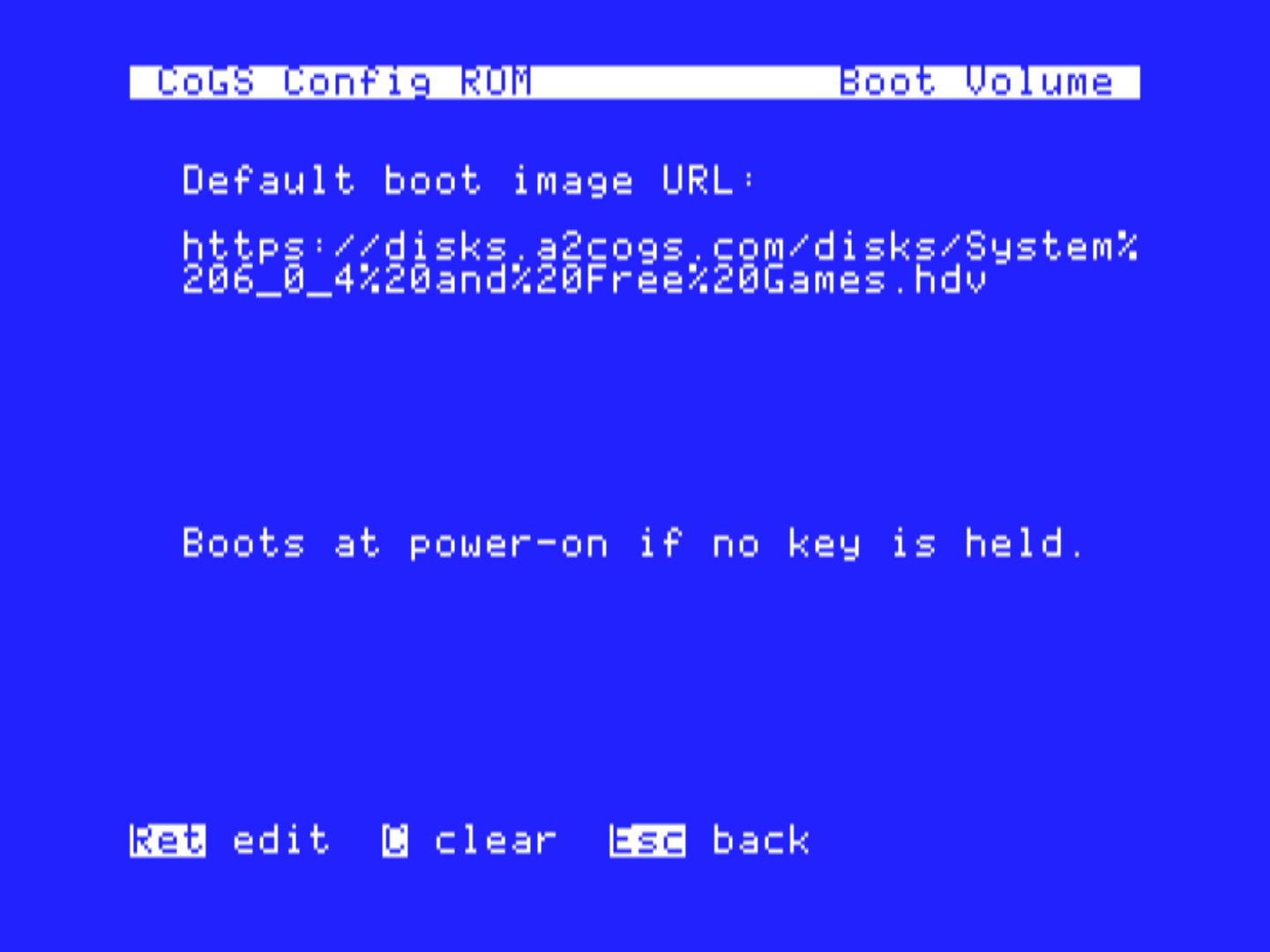
Boot Volume: the image the machine boots at power-on, set from Browse or typed as any URL
Disk Drives: the multi-unit mount table, images mounted from the network as SmartPort units, R for recent disks
Recent Disks: the last twelve volumes mounted or booted, newest first, 1-9 or Return to mount on the selected drive
Image/Audio Source: a2cogs.com indexes on every Browse hub; your own share adds a Y row beside it for disks, audio, and pictures, with a one-key LAN scan for a CoGS Image Manager share
The config ROM main menu on an Apple //e: Network, Media, and System sections with live link, SSID, IP, card, and slot status, green phosphor and all
Card Status from ROM on an Apple //e: link, IP, MAC, signal, public IP, time sync, and card vitals

Tools in ROM, updates over the air

The card looks after itself, and shows its work on the Apple's own screen. Network Tools in the ROM run DNS lookup, ping, traceroute, TCP port checks, a one-key connectivity self-test, and a WAN-to-card speed test, all executed on the card. And About / Update fetches the release list from a2cogs.com so the card can download, verify, and flash new firmware right from the machine. No cable, no other computer, ever.

Network Tools menu in the config ROM: DNS lookup, ping, continuous ping, traceroute, TCP port check, connectivity self-test, and the WAN-to-card speed test
Ping google.com from the config ROM: five replies with times and a summary
Traceroute to google.com from the config ROM, hop by hop with round-trip times
Speed test from the config ROM: a 256 KB HTTPS GET from speed.cloudflare.com, setup 0.21 s for DNS and TLS, then the rate in KB/s and Mbit/s. This is the card, not the IIgs; the GS bus is not in this path
About / Update from ROM: firmware 1.14, the card services and streaming it offers, U for the over-the-air update list, the release list fetched from a2cogs.com with sizes and dates, build notes per version, pick one and the card flashes itself
Firmware update list fetched from a2cogs.com: versions with dates and build notes, pick one to download and flash

A library on the wire

The card ships pointed at the index at a2cogs.com: 1036 disk images, boot tested, searchable and mountable right from the machine. Browse Disks opens on a hub, "What do you want to do?": play a game (759), music & art (95), educate & learn (121), utilities & work (51), demos, go online, or the whole shelf by machine (403 GS titles, 640 8-bit) and A to Z. The GS side is built on the collection curated at What is the Apple IIGS?, credited on every entry. Total Replay streams directly from its own GitHub release, so its 519 8-bit titles ride along as their own rows, always the latest version. An 8-bit Apple sees only what it can run. Don't take our word for it: browse the live index in the card's own interface, right in your browser, same keys and all.

Browse Disks hub in the config ROM: Featured 3, Play a game 759, Music & art 95, Educate & learn 121, Go online 1, Utilities & work 51, Demos & odds 9, GS titles 403, 8-bit titles 640, All disks 1036, Find by name
The Play a game shelf: 759 disks, 43 pages, size and 8b for 8-bit software, B for boots, boot on Return or assign to a drive
The Educate & learn shelf: 121 disks, 40,000 Selected Words, Alge-Blaster, Alice in Wonderland, Banner Books, Big Book Maker, size and 8b for 8-bit software, B for boots
The hub on an Apple //e, 8-bit only: Play a game 528, Educate & learn 102, all 640 disks, green phosphor and all

Your library too: CoGS Image and Audio Manager

Your own disk images, music, and pictures work the same way. Run the CoGS Image and Audio Manager on a Mac (v1.5; Windows and Linux planned), point it at one library folder, subfolders and all, and click Start Sharing. Every CoGS card on the LAN can scan for the share from the Image/Audio Source page and browse it like the a2cogs catalog: bootable tags from real boot-block probing, search, full read/write on disks, Browse Audio for the music, Browse Pictures for the art.

Your folders become categories on the Apple. Mark a folder with the purple ][ chip in the sidebar (every top-level folder starts marked), give it a label if you like, and press Y on any Browse hub: the card lists your share as "Your source" with one numbered row per folder and its count, then All A-Z and Find by name. A folder of GS games, a folder of 8-bit games, a folder for the kids: that is the menu. The Mac side shows the folder tree, a Folder column, a per-row activity light while the card reads or writes, Show in Finder, and a dated Snapshot of any disk image before you let something write to it. Sidebar, Finder-style columns, IIGS and 8-BIT themes, and a headless cogs-share command line for a Mac in a closet. If the Mac picks up a new address, the card notices on the first fetch and S rescans the LAN.

CoGS Image and Audio Manager v1.5: library sidebar with Disk Images, Audio, Pictures and the folder tree, folders marked ][ as Apple II categories, Type I/A/P column, Volume/Length, LAN URL ready to copy
CoGS Image and Audio Manager v1.5 in the 8-BIT green-phosphor theme: same library sidebar and folder tree
Apple II Categories sheet in the Image Manager: which folders the card lists, their labels and order, Add Folder for nested ones, Prefix subfolder in names, Reset to Defaults
Your source on the card: the share's folders as numbered rows with counts, then All A-Z and Find by name
One of your folders listed on the card: the disk images inside it, B for boots, mount or boot on Return
Browse Disks hub with an Image Manager share saved: the a2cogs shelves, All disks, Find by name, then Your source on its own row
Sharing on the LAN today · Image Manager 1.5 · folders as categories with firmware 1.13

What it unlocks

So what can my Apple do now?

With a secure link to the modern web and a co-processor on board, the question stops being “can it?” and starts being “what will you build?” A couple of these are ours to finish; the rest are possibilities, most of them yours to write.

Available

Talk to AI

GS-LLM, our streaming LLM chat client, plus room for an AI dungeon master for text adventures, on-the-fly translation, or a button that summarizes any web page to the screen.

Live data, on the desktop

Weather, stock tickers, sports scores, headlines, transit times — pulled fresh from real APIs into a desk accessory.

Real messaging

Email over genuine TLS, IRC and chat bridges, a Mastodon client, an RSS reader. The GS back on the live network.

Available

Mining & crypto

GS-Miner, our Bitcoin miner getting the hardware nonce scanner, plus hashing utilities and a password vault seeded by true randomness.

Available

Cloud & sync

Pull files and updates from a web server or GitHub, back up to the cloud, and mount or boot fresh disk images straight off the network — no copying to local storage first.

Available

Listen and look, on the GS

The same CDA plays SoundSmith songs, the PCM shelf, and internet radio through the Ensoniq (Tool219 and Petar Puskarich’s Tool226), and shows 724 box covers and title screens. The Mac Image and Audio Manager shares your own disks, music, and pictures from one URL.

Play with the world

Post high scores to an online leaderboard, turn-based multiplayer, daily shared puzzles delivered over the wire.

Secure by default

TOTP two-factor codes (the card keeps real time), signed requests, and downloads that are certificate-checked on the card.

Whatever you dream up

It is a slot card with an HTTPS pipe and a toolbox. This community has always done the rest. Possibilities are endless.

For developers

Build your own app for the card

CoGS is not a black box. The building blocks are open: a documented protocol that runs over the slot, plus client code so your program can open a connection, fetch over HTTPS, hash data, or pull true randomness in a few calls. Call it an API if you like, but the point is the opposite of a cloud service you rent. The card is right there in the machine, and it is yours.

Develop without the hardware. A virtual CoGS card runs inside the Ample emulator (and MAME), so you can write and test apps with no card on your desk. It links the same firmware core the real card runs, with live networking through your Mac (DNS, TCP, HTTP, JSON) and a LAN bridge so Marinetti and IP65 software reach the real network. One command sets it up, and the same binary then runs on real hardware. TLS and HTTPS happen on the card’s crypto, so in the emulator use plain HTTP or a local TLS proxy.

Designed for CGS

A mark we want to offer for software built to use the card, so apps that light up your Apple II with modern powers are easy to spot. The seed of a full suite of modern Apple II software, written by the community, running on the machine itself.

The constraint

Apple II Forever.

We mean it as an engineering constraint, not a slogan.

CoGS refuses to become the brain. It would be easy, and wrong, to build a card that runs the program on its own fast processor and hands the Apple II a finished picture. That is not an Apple II anymore. That is a modern computer in a beige case.

CoGS is a co-processor. It does only the work the machine genuinely cannot: it terminates TLS, it hashes, it makes true randomness, it walks JSON, it grinds nonces. In every case the Apple II decides what to ask for, runs the program, and owns the screen and the user. The card is a tool on the bench, not a hand on the wheel.

The story

It started with apps, not a card.

It began with building things for these machines: a Bitcoin miner, then a modern LLM chat client for the Apple IIGS. Each one ran into the same wall: the modern internet's cryptography simply can't run on a 1 MHz 6502 or a 2.8 MHz 65816. There are already good answers to that. Some run the real program on another computer and leave the Apple as a terminal. Others, like the excellent FujiNet, put a dedicated device on the disk port that has been terminating TLS for vintage machines for years, with the Apple still running the show. Offloading the hard cryptography is the right idea, and CoGS stands squarely on that prior art. What I wanted was a different shape for it: not a helper beside the machine but a true card inside a slot — bus-native, mapped right into the machine so the program can call it in a few register writes. The Apple still owns the program, the screen, and every decision. The card just does the parts the silicon of 1986 never could.

What made it feasible was modern tooling. Designing the protocol, writing the firmware, and bringing up the clients with AI-assisted development in Cursor turned what would once have been years into an iterative, almost playful loop — sketch an idea in the morning, have it answering on real silicon by the afternoon. That speed is the point: it unlocks the imagination to actually ship working software for a forty-year-old computer.

So much of the hard groundwork was already laid by this community — the bus interface, the TCP/IP stacks, the toolchains — that the next step felt obvious: build one card that drops into any slotted Apple, with a whole suite of capability on board, to empower the next wave of software and keep our favorite computers alive long into the 21st century (and beyond).

Built on shoulders

Open source. Open hardware. Community.

Build the firmware

It runs today on the CoGS card and on an open A2Pico carrier fitted with a Raspberry Pi Pico 2 W. The protocol lives in a written spec that the firmware follows — now including the SmartPort/ProDOS block layer for network disks — with docs that walk through how it all works. Source, spec, and clients go up on GitHub at launch, with prebuilt firmware and the bootable GS disk on the releases page.

cd firmware && cmake -B build -G Ninja \
  -DPICO_BOARD=pico2_w -DCMAKE_BUILD_TYPE=Release
cmake --build build   # -> cogs.uf2

How can I get one?

Built to run on hardware you can already get.

The purpose-built CoGS card, with Wi-Fi and wired Ethernet on one board, is shipping soon: sign up above to be first in line. Until then CoGS runs on parts you can already get: an open A2Pico carrier (the proven Apple II slot card) with a Raspberry Pi Pico 2 W on it for Wi-Fi.

Latest firmware v1.14streaming network disks, eight drives live in the Finder, recent disks under Featured and on Disk Drives R · 1000+ disk images by category · SoundSmith + PCM audio and internet radio · box art and title screens (SHR, HGR, DHGR) · CoGS Image Manager shares with your own folders as categories · Marinetti bridge · over-the-air updates

The board

The software

CoGS Card purpose-built, Wi-Fi + Ethernet · shipping soon · sign up Firmware Download cogs.uf2 · coming soon A2Pico Multi-Function Card Available at JCM Bootable GS disk cogsall.2mg · desk faces + Marinetti · coming soon Raspberry Pi Pico 2 W to add WiFi capability to the A2Pico USB Mac Bridge (prototype) no-radio Lite / A2Pico · firmware 0.90

Note: A2Pico boards come with a Pico W. You'll need to desolder and solder on a Pico 2 W for Wi-Fi.

Manuals are up now. Firmware, spec, and GS software go public at launch. Flash once; updates come over the air from CoGS Config.

First batch goes out in sign-up order. Questions to [email protected].